





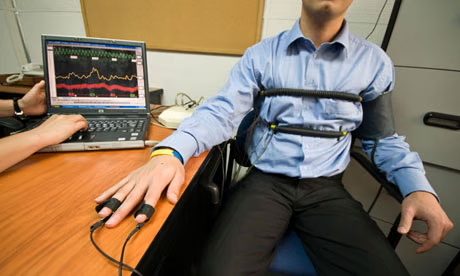
Polygraph tests have this strange reputation. Part science, part theater. You’ve seen them in crime shows—wires attached, questions fired, tension rising. The machine spits out a verdict like it knows your secrets better than you do.
But here’s the thing. Real life isn’t that clean.
People walk into polygraph exams nervous, skeptical, sometimes convinced they’ll “beat the system.” Others trust the process completely. Somewhere in the middle sits the truth—and it’s a lot messier than most expect.
Let’s dig into what a polygraph test really does, and whether fooling one is actually possible.
What a Polygraph Is Actually Measuring
A polygraph doesn’t detect lies. That’s the first myth to clear up.
It measures physiological responses—heart rate, breathing patterns, blood pressure, and skin conductivity. In simple terms, it tracks how your body reacts when you answer questions.
The assumption is straightforward: when people lie, they get stressed. That stress shows up in their body. The machine records those changes.
Sounds logical, right?
But now imagine this. You’re sitting in a quiet room, hooked up to sensors, being asked questions about something serious—maybe even something you didn’t do. Your heart’s pounding anyway. Your palms are sweating. Your breathing’s off.
That’s not guilt. That’s pressure.
And that’s where things start to get complicated.
The Human Factor No One Talks About
Let’s be honest—people aren’t consistent.
One person lies smoothly without blinking. Another gets anxious ordering coffee if the line is too long. So when both take a polygraph, who looks more “truthful”?
Not always the innocent one.
Examiners know this, which is why the process isn’t just about the machine. There’s a human interpreting the data. They look for patterns, compare responses, and ask control questions designed to create a baseline.
For example, they might ask something like, “Have you ever lied to avoid trouble?” Most people have. That question helps establish what your “lying response” looks like.
Then they compare it to your answers about the main issue.
But here’s the catch: those interpretations aren’t foolproof. Two examiners can look at the same chart and disagree. It happens more often than you’d think.
So… Can You Actually Fool It?
Short answer? Sometimes. But not in the way movies suggest.
You don’t just sit there thinking “I’m calm, I’m calm” and magically beat the machine. It’s not that simple.
People who try to manipulate a polygraph usually fall into two categories. First, those who try physical tricks. Second, those who try mental strategies.
Physical Tricks: The Old-School Approach
You’ve probably heard of these.
Biting your tongue. Pressing your toes into the floor. Altering your breathing. The idea is to create spikes in your physiological response during control questions, so your real answers don’t stand out.
In theory, it makes sense.
In practice? Risky.
Examiners are trained to spot these behaviors. Subtle shifts in posture, irregular breathing patterns, or repeated movements can raise red flags. If they suspect manipulation, the results can be thrown out—or worse, interpreted against you.
There’s also the reality that maintaining these tricks consistently under pressure is harder than it sounds. You’re already nervous. Now you’re adding another layer of control.
That usually backfires.
Mental Strategies: The Quiet Game
This is where things get more interesting.
Some people try to control their emotional responses instead. They detach. They reframe questions. They convince themselves their answers are true—or at least justified.
Imagine someone thinking, “I didn’t really steal it, I just borrowed it.” That shift can reduce stress, which affects the readings.
Others use meditation techniques or focus on calming thoughts to keep their baseline steady.
Does it work?
Sometimes. But again, it depends on the person. Emotional control is a skill, and most people don’t have that level of control under scrutiny.
Plus, examiners often conduct pre-test interviews designed to break through that calm. They’ll push, probe, and watch how you react before the test even starts.
The Role of Anxiety (and Why It Matters More Than Guilt)
Here’s a scenario.
Two people take the same polygraph test. One is guilty but calm. The other is innocent but anxious.
Who fails?
Not always the guilty one.
This is one of the biggest criticisms of polygraph testing. It doesn’t measure deception directly—it measures stress responses that may be linked to deception.
That’s a big “may.”
People with anxiety disorders, PTSD, or even just a fear of authority can show heightened responses across the board. On paper, that can look like deception.
On the flip side, someone who’s confident, practiced, or simply less reactive might pass—even if they’re not telling the truth.
That imbalance is why polygraphs are controversial, especially in legal settings.
Are Polygraph Results Even Admissible?
In many places, polygraph results aren’t allowed in court.
That alone tells you something.
Judges tend to view them as unreliable because of the subjective interpretation and the variability in human responses. They can be used in investigations, sometimes in employment screenings for certain jobs, but not as definitive proof of truth or deception.
Think of them more as a tool—not a verdict.
Law enforcement might use a polygraph to guide questioning or gauge reactions, but they won’t rely on it alone to build a case.
Why People Still Believe in Them
Despite all the limitations, polygraphs haven’t disappeared.
Why?
Because they work—just not always in the way people think.
The real power of a polygraph is psychological.
Sitting in that chair, connected to a machine that’s “watching” your body, can be intimidating. People often believe the test will expose them no matter what. That belief alone can lead to confessions or slip-ups.
There’s a kind of pressure that builds in that room.
Someone might walk in thinking they’ll lie their way through it. Then the examiner explains how accurate the machine is, how it catches even subtle deception, how “it’s better to be honest now.”
And suddenly, the person starts second-guessing themselves.
That’s not the machine. That’s the setup.
A Quick Reality Check
Let’s cut through the myths.
You can’t reliably train yourself overnight to beat a polygraph. There’s no guaranteed trick that works every time. And the idea that the machine is a perfect lie detector? That’s just not true.
It sits somewhere in between.
Some people beat it without trying. Others fail despite telling the truth. Most fall into a gray area where the results depend on interpretation.
If anything, the test reveals how unpredictable human physiology can be under pressure.
When Polygraphs Show Up in Real Life
You’ll see polygraphs used in a few common situations.
Job screenings for certain government or security roles. Internal investigations. Criminal cases where investigators want another layer of information.
Picture someone applying for a sensitive position. They’re asked about past behavior—drug use, theft, things like that. Even if they’ve been honest in their application, the polygraph adds another layer of scrutiny.
Or think about a workplace investigation. Something goes missing, and a few employees are asked to take a polygraph. Suddenly, it’s not just about facts—it’s about how each person reacts under questioning.
These situations can feel intense, even if you’ve done nothing wrong.
So What Should You Do If You Ever Take One?
The simplest advice tends to be the most practical.
Go in rested. Answer honestly. Don’t try to outsmart the process.
That last part matters more than people think.
Trying to manipulate your responses often creates more irregularities, not fewer. It’s like overcorrecting while driving—you end up swerving more.
Also, understand what the test can and can’t do. It’s not reading your mind. It’s recording physical signals that can be interpreted in different ways.
If you’re nervous, that’s normal. Everyone is.
The Bottom Line
Polygraph test sit in an odd space between science and psychology. They’re not useless, but they’re far from perfect.
Can you fool one?
Yes, sometimes—but not reliably, and not easily. And not always intentionally.
That’s the real twist. It’s not about beating a machine. It’s about how your body reacts under pressure, how your mind handles stress, and how someone else interprets those signals.
In other words, it’s less like a lie detector and more like a mirror—one that doesn’t always reflect things clearly.
And that’s why the question isn’t just “Can you fool a polygraph?”
It’s whether the polygraph can truly understand you in the first place.