





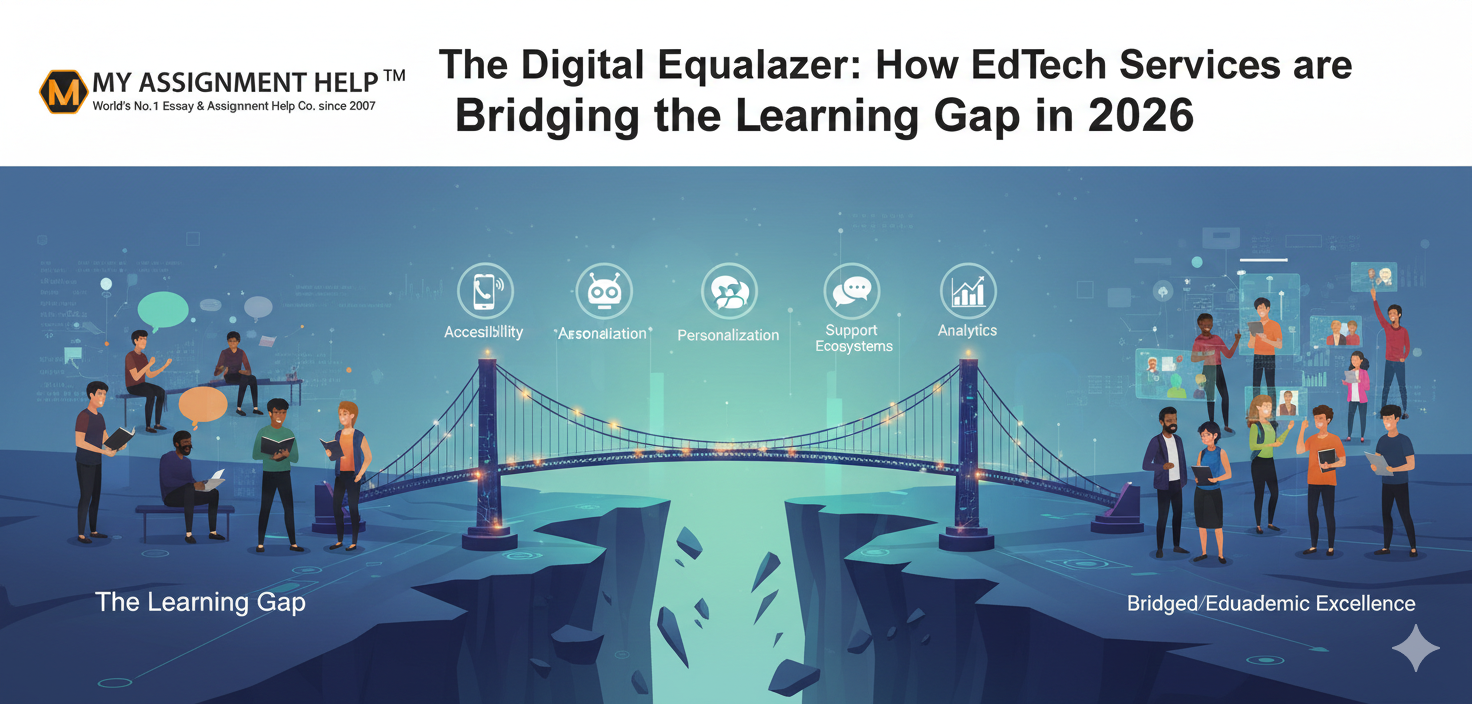
The educational landscape of 2026 looks fundamentally different than it did even five years ago. We have moved past the era of “emergency remote learning” into a sophisticated, AI-integrated, and hyper-personalized ecosystem. Yet, as technology advances, the “learning gap”—the disparity between a student’s academic performance and their actual potential, often exacerbated by socioeconomic factors—remains a critical challenge.
In 2026, Education Technology (EdTech) is no longer just a digital substitute for paper; it is the bridge. By leveraging data analytics, adaptive learning platforms, and 24/7 support structures, EdTech is successfully narrowing the divide for millions of students globally.
The State of the Learning Gap in 2026
Despite global efforts, the “homework gap” and “achievement gap” persist. According to 2025 data from the National Center for Education Statistics (NCES), students in underfunded districts still face a 25% proficiency deficit compared to those in high-income areas. However, the integration of high-speed 6G connectivity and affordable hardware has shifted the bottleneck from access to support.
The modern learning gap is characterized by a lack of personalized instruction. In a traditional classroom of 30 students, a teacher cannot cater to 30 different learning speeds. This is where EdTech intervenes, offering asynchronous tools that allow students to master concepts before moving forward.
Personalized Learning Path: The End of “One Size Fits All”
One of the primary ways EdTech is bridging the gap is through Adaptive Learning Technology. These platforms use AI to analyze a student’s strengths and weaknesses in real-time. If a student struggles with algebraic equations, the system doesn’t just give them a failing grade; it pivots, offering foundational videos and practice problems to address the root misunderstanding.
For many students, the pressure of keeping up with a rigid curriculum can lead to burnout. To alleviate this stress, many turn to specialized academic support services. When the complexity of modern coursework becomes overwhelming, students often look for experts to do my homework online to gain a clearer understanding of complex methodologies through solved examples. This supplemental support acts as a safety net, ensuring that one difficult week doesn’t derail an entire semester.
Breaking Geographical Barriers with Global Expert Pools
In 2026, your physical location no longer dictates the quality of your education. A student in a rural town now has the same access to PhD-level tutors as a student in a major metropolitan hub. This democratization of expertise is vital for specialized subjects like Law, Nursing, or Advanced Engineering.
For instance, students in the United Kingdom have seen a significant rise in tailored academic assistance that aligns with the specific standards of the Office for Students (OfS). Whether it’s tackling a complex dissertation or a technical case study, the ability to hire professionals to do my assignment has allowed students to maintain high academic standards regardless of their local institutional resources. This globalized approach to tutoring ensures that “educational deserts” are becoming a thing of the past.
Data-Driven Insights: Predicting Failure Before it Happens
Predictive analytics is perhaps the most “silent” yet powerful tool in the EdTech arsenal of 2026. Schools are now using “Early Warning Systems” (EWS) that track engagement metrics—how long a student spends on a reading, their performance on micro-quizzes, and even the sentiment of their forum posts.
- Source: A 2025 study by the Oxford Internet Institute found that AI-driven early intervention reduced course dropout rates by 18% in hybrid learning environments.
By identifying “at-risk” students weeks before a midterm exam, educators can provide targeted interventions, effectively closing the gap before it widens into a failing grade.
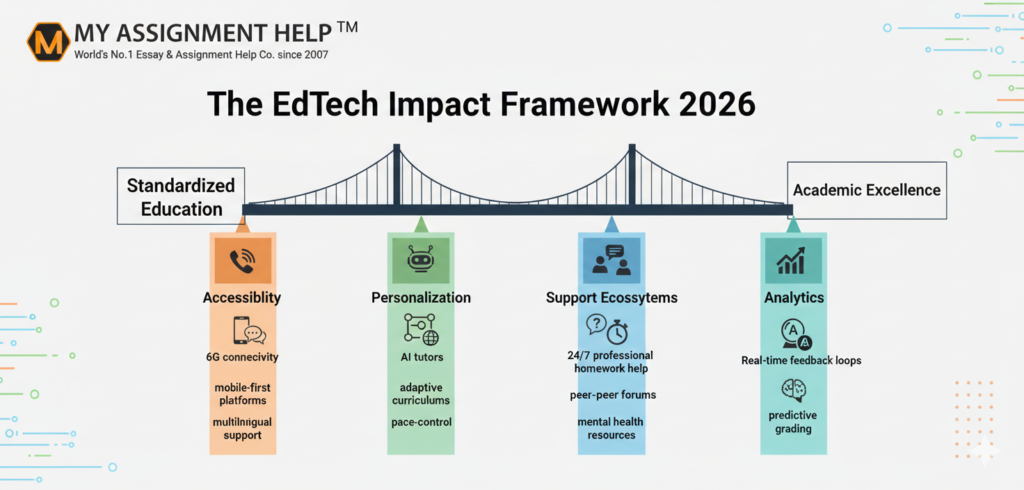
Key Takeaways: The 2026 EdTech Shift
- Hyper-Personalization: AI now tailors curriculum in real-time to match student cognitive loads.
- Equity through Access: High-quality tutoring and academic resources are now available 24/7, regardless of geography.
- Proactive Intervention: Data analytics allow educators to support students before they fail, not after.
- Holistic Support: Services that provide homework and assignment assistance are integrated into the learning journey as legitimate “supplemental instruction” tools.
The Human Element in a Tech-Driven World
While the technology is impressive, the “bridge” is ultimately built on human expertise. The most successful EdTech platforms in 2026 are those that combine seamless UI with access to human mentors. The rise of “Hybrid Tutoring”—where AI handles rote memorization and humans handle critical thinking—has proven to be the most effective model for closing the achievement gap.
According to World Economic Forum reports on the Future of Jobs, the ability to synthesize information is more valuable than ever. EdTech services assist this by handling the “process” work, allowing students to focus on the “application” of knowledge.
Conclusion
The learning gap is a complex, systemic issue, but EdTech in 2026 provides the most robust toolkit we have ever possessed to dismantle it. By offering personalized paths, 24/7 expert support, and data-driven insights, we are moving toward a future where a student’s potential is limited only by their ambition, not their circumstances.
Frequently Asked Questions (FAQ)
Q1: Is EdTech replacing traditional teachers in 2026?
No. EdTech is acting as a “force multiplier” for teachers. It handles administrative tasks and basic tutoring, allowing teachers to focus on mentorship and complex emotional support.
Q2: How do academic support services ensure integrity?
Leading services in 2026 use “Learning-First” models. Instead of just providing answers, they provide step-by-step explanations and interactive sessions to ensure the student understands the “why” behind the “how.”
Q3: Is 6G necessary for these EdTech tools to work?
While 6G enhances VR and AR learning, most bridge-building EdTech tools are designed to be “lightweight,” meaning they can function effectively on 4G and 5G connections to ensure inclusivity.
Q4: Can EdTech help students with learning disabilities?
Absolutely. 2026 EdTech includes built-in tools for neurodivergent learners, such as speech-to-text, dyslexia-friendly fonts, and AI that adjusts content density for those with ADHD.